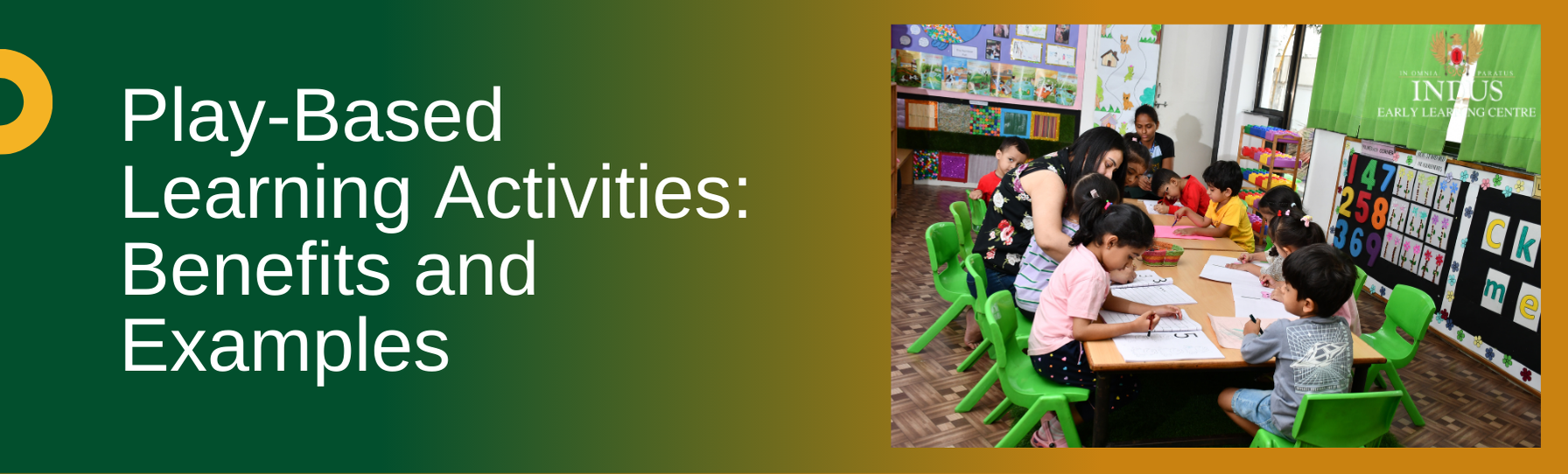
Play-Based Learning Activities: Benefits and Examples

Play-Based Learning Activities: Benefits and Examples

Play-Based Learning Activities: Benefits and Examples

A child’s early years are crucial for the development of their brain. Neural connections form rapidly throughout this time, impacting a child’s capacity for learning, problem-solving, and social interaction. As educators at Indus Early Learning Centre, we respect these formative years and think that a child’s innate curiosity and desire to play are excellent foundations for a lifelong love of learning.

What are Play-Based Learning Activities?

Play-based learning activities enable children to learn and develop by actively exploring, experimenting, and interacting with their surroundings. These activities are intended to be child-driven, which means they are begun and guided by the child’s interests, with teachers providing guidance and assistance to ensure learning objectives are fulfilled. 


Teachers can scaffold learning by providing open-ended materials, prompting questions, and introducing new concepts or problems that are somewhat higher than the child’s current developmental level. This strategy allows students to learn at their own pace while gaining a complete understanding of the concepts being covered.

Benefits of Play-Based Learning Activities

The benefits of play-based learning activities are numerous and include a child’s cognitive, social, emotional, and physical growth. Here are several significant advantages:

Cognitive Development: Play serves as a springboard for cognitive growth, allowing youngsters to experiment, solve issues, and think critically. Consider a toddler making a block tower. They make assumptions about the block and start experimenting with its balance, adjusting their tactics as needed.

Social and Emotional Development: Play is also a wonderful time for social and emotional growth. Children learn how to engage with others, read social cues, share, take turns, and express themselves.

Physical Development: Play-based learning also encourages children to develop their physical skills. Play teaches youngsters how to balance, hop on one foot, throw and catch a ball, and practise a range of other fine and gross motor skills.

Language Development: One of the most significant advantages of play-based learning is that it helps youngsters acquire reading and language skills. Children learn new words and improve their language skills through play-based activities. Along with learning the structure and meaning of new vocabulary, it also helps kids draw connections between written and spoken forms of expression.

Play-based learning activities enable children to learn and develop by actively exploring, experimenting, and interacting with their surroundings. These activities are intended to be child-driven, which means they are begun and guided by the child’s interests, with teachers providing guidance and assistance to ensure learning objectives are fulfilled. 


Teachers can scaffold learning by providing open-ended materials, prompting questions, and introducing new concepts or problems that are somewhat higher than the child’s current developmental level. This strategy allows students to learn at their own pace while gaining a complete understanding of the concepts being covered.

Top 5 Examples of Play-Based Learning Activities

Our dedicated teachers at Indus Early Learning Centre incorporate a variety of play-based activities into our curriculum, ensuring a well-rounded learning experience for every child. Here are a few examples:

Block Play: Block play involves projects of construction using blocks or legos. This helps them make sense of the world, they develop problem-solving and social skills and improve their fine motor development.

Sensory Play: This involves activities that utilise sensory materials such as sand or mud to help the children enhance their five senses fostering curiosity from an early childhood.  The children become more sensitive to the world around them and learn new motor skills that are often crucial.

Dramatic Play: Children engage in pretend play when they use their imagination to make up stories and scenarios. It may include puppetry, storytelling, small-world setups, and dramatic performance.

Art and Craft Activities: Children can explore colour and texture, improve their fine motor skills, and express themselves creatively through creative activities like painting, drawing, and collage. Creative expression can be facilitated through engaging in art and craft activities.  Children can experiment with colour, texture, and various artistic mediums through painting, drawing, and collage activities.  In addition to fostering their creativity, these activities help them improve their fine motor skills, which are necessary for performing tasks like holding a pencil and handling small objects.

Storytelling and Singing: Reading stories, singing songs, and creating stories together fosters language development, builds memory skills, and encourages imagination. These activities help to develop the understanding of language. When kids read stories together, they are introduced to new words and story structures. The foundation for future literacy success is primarily laid by storytelling and singing, which encourage creativity and a love of language.

Conclusion

Finally, the range of play-based learning activities offered at the Indus Early Learning Center goes beyond simple entertainment.  Playing lays the foundation for children’s cognitive, social, emotional, and physical development as they embark on a voyage of discovery.  

Our committed educators provide a stimulating atmosphere where kids can explore their interests at their own speed and develop a lifelong love of learning that will benefit them in school. We cordially encourage you to explore our unique surroundings and learn how your child’s play might lead to new prospects.

FAQs- Benefits Of Sports For Students

Q1- What are the 4 key parts of sports?

There are 4 key physical elements involved in any sport and they are strength, speed, conditioning, and positioning.

Q2- What are the 5 Cs of Sports?

There are 5 main takeaways in sports called the 5 Cs of sports. They are mainly Commitment, Communication, Concentration, Control, and Confidence.

Q3- What are the benefits of sports for children?

Many benefits of sports in children include reduced risk of obesity, increased cardiovascular fitness, and healthy growth of bones. Additionally, it can also be a career path as well as a healthy hobby.